Sunday, April 3, 2016

Children's Church


It's always a blast when the Children's Church performs with us during worship!

We know that the Bible tells us in Matthew that when the disciples asked Jesus who would be the greatest in his Kingdom (heaven), He answered them, "Unless you turn and and become like children, you will never enter the kingdom of heaven."

Clearly, children held a special place in the heart of Jesus!

It's awesome that we have these kids involved with our church, and it's great to have adult leaders who are willing to give of their time and talents to work with them.

Here they are singing "Lord I Lift Your Name on High" and "I Love You, Lord" for us.


Sunday, March 20, 2016

"The Day He Wore My Crown"


Palm Sunday, March 20, 2016

The SSBC Worship Choir has been working since the last week of January on this presentation for Easter.  Today, the hard work paid off in a tremendous performance of "The Day He Wore My Crown" for the folks in attendance at Springfield Southern Baptist Church.

Too often, we tend to overlook just how much work goes into such a performance.  It's the culmination of hours of rehearsal together as a group, plus countless hours of work by each individual member on their own.

Then there is the huge amount of talent and work that Doug Phillips and his instrumentalists invest in giving the choir all the musical support it can, sounding like an entire orchestra is behind us!

The end result is a musical deliverance of the most important message in history: the death, burial, and resurrection of Jesus Christ, the sacrificial Lamb who wore a crown of thorns and suffered for us. The Easter story.

In the program for the performance was this excerpt from the description of the musical:

"From the moment Jesus was born, His whole life was about one thing: fulfilling His mission as the Lamb of God who would be slain for our sins...The cross is a constant reminder of just how far Love was willing to go to save us."

We, as a choir, were honored to be a part of this message today.  As their director, I am proud of each one of them and their efforts in this presentation.

Sunday, December 20, 2015

"But Aren't We All Children..."

Christmas is my favorite holiday, without question.  Today's worship service was a Christmas smorgasbord of stories, children singing, and instruments joining the praise!

Here is a guitar instrumental arrangement of "Carol of the Bells" to get the service started.


The Children's Choir blessed us with their own special arrangements of "Go Tell It on the Mountain" and "Emmanuel".
The church joined in for a time of sharing stories of their favorite memories of Christmas.  After several people shared their memories, I shared my own story of my favorite Christmas of all.
Sometimes, sharing Christmas in an informal setting can be very meaningful. This was one of those times.   
An old song goes, "Christmas is for children..."  For this child of God, that's perfect! 

Monday, September 7, 2015

Worship. That Is All.

A recent blog by self-proclaimed “eclectic writer” Thom Schultz on the state of worship in today’s church has been an igniter of a ton of responses—pro and con to Mr. Schultz’s stand.  (Click here to read his blog.)

The article is titled “Why They Don’t Sing on Sunday Anymore”.  It is mostly an indictment on today’s church worship services. 

I have no problem with people offering opinions.  Where I have an issue is when the author states opinions or a position on a perceived problem, but then doesn’t offer any solution.  What that amounts to, in my opinion, is just wordy complaining. 

From what I can find out about Mr. Schultz, which is precious little, he has never led worship in a church environment.  So, that colors my response to his article to begin with.  However, I am not saying that he doesn’t make any valid points.  He does.  These are things to consider.

The larger problem, though, are some of the responses I’ve seen.  Many have taken his article and have made it a battle flag for their preferred style of worship.  They are missing the point entirely.

I have many thoughts on this, particularly in my calling as a worship leader. And there are valid points in all of the responses I read, as well as the author's main points. But I will say this: Worship is a choice. Period. God admonishes us to sing praises to him. Eighty times in scripture. Not once does he ever say "If you like the style of music..."  (Lifeway’s Mike Harland has a great article on this at WorshipLife.com.  Click here to read that article.) 

Some responses to Mr. Schultz’s article tried to reduce the question of worship to the silliest arguments. If your only sticking point in regards to a worship service in today’s church is that your church uses a "projector instead of hymnals," you need to revisit your argument.  Sorry, but that's no more valid than the old "pews versus chairs."  And yet, I’ve seen churches nearly split over just such silliness.

We just finished "Worship Arts Month" at my church, and one Sunday we did a "Hymn Sing" in which we went through a medley of 28 hymns, all chosen by the congregation, and not once did I say "turn to page..." It was all on-screen. And the congregation loved it.

Let's dig a little deeper...

We look for--and find--too many reasons not to worship today. Unfortunately, the subjectivity of music is the easiest to jump on. We want good musicians and leaders, but we want to bottle them into our own version of worship. We want to participate in worship--as long as it's the music we like and the style we prefer.

Let me make this clear: God. Doesn't. Care. He wants us to CHOOSE to worship him, and he wants it to be authentic. And, oh by the way, he wants us to sing.

We all want to package worship--particularly the music of worship--into a little box that looks exactly like what we grew up with. That's the only acceptable version to us. No projector. No words on screen. No band. Hymnals only. Nothing with any newer language than King James. (Do we really expect younger generations to understand--let alone worship while singing--"Let the Lower Lights Be Burning"?) Now THAT'S worship!

While we're at it, shouldn't we also go back to the days of no air-conditioning and hard pews? (I do have fond memories of those funeral home-provided fans in the racks of the pews...) The point is, we are happy with some changes--or at least more accepting of them--but changing something like music and worship is off limits. Didn't we get used to air-conditioning? I know I did! Might we be able to learn the new worship music? Shouldn't we be willing to give it a chance?

Yes, there are ways of teaching the church new music, and shoving it down our throats is definitely the wrong way. That's why the "job" of worship leader is so much more challenging than ever before. Sometimes, we do it wrong. Sometimes, leaders say, in essence, "Here's the new music. If you don't sing it, you're lost!" That's wrong. Sometimes, leaders try to force their own preferred style on the church. That's wrong. But, sometimes, leaders are pressured by the "power brokers" of the congregation to lead worship the way they want it! (Yes, it has happened!) It's a tough calling these days.

I am 61 years old. I'm a PK, so I've been leading music in church since I was tall enough to see over a pulpit! I've been through the "hymnals only," and I've been through the "Jesus Movement." I've been on staff at a church when it was called "Music Leader" and "Music Director" and now “Worship Arts Director.”  I've been a touring musician and I've been a choir member. And I've worshiped in the congregation while someone else led. I've seen just about all there is to see--so far--in a worship service. Believe me, I've seen the good and bad. I've been harsh in my criticism and I've been liberal with my accolades. Through it all, I've learned that authentic worship is just that--worship.  It's not a style of music. And worship is a choice.

On the other extreme from the "Hymnals Only" army, there are the "entertainers" such as the author mentions in this blog. And they are wrong as well. I see worship leaders and band members like that everywhere, including in local churches where I live. It's a show. The actual heart of worship is lost amidst flashing blue lights and extended guitar solos. Is there a place for that? I absolutely believe there is! I strongly believe in Christian entertainment and letting these artists display their gifts. But I prefer that in venues where the audience is there for that reason. And don't get me wrong, I've been to MANY Christian music concerts where worship broke out! I love it!

But in a corporate environment on a Sunday morning, we need to be cognizant of our people and do what we can to meet their needs and lead them all to worship. Today's church is increasingly multi-generational. What are we doing to lead them in worship? I can assure you that the answer is NOT to cater to the musical tastes of any one particular group!

And that's why my calling is so extremely difficult in today's church. Most of us really do have our hearts in the right place. We're trying. Believe me. We're trying to make it a worship experience for all ages. In today's church, we may have people who grew up with no "music director" and hymnals only. (And maybe hard pews with no pads?) Two rows behind them may be a young couple whose exposure to worship music is what they hear on K-LOVE. And we're trying to make it a worship experience for them all.

But we all, as a church, have to do our part.  We need to get over ourselves, and as Matt Redman says in his wonderful worship song, get back to "the heart of worship." Stop saying that hymns are better lyrically than modern worship music (I'll put "Whom Shall I Fear" and "Love Ran Red" up against any song in any hymnal for spiritual message!).  Stop saying that this "new" worship music is too repetitive unless you're also willing to strip "When the Roll Is Called up Yonder" (and others) from the hymnals.

See, when we focus on the music, we can all find ammunition for our Battle of Worship Style. 
But, what if we tried to find common ground in worship instead of sitting there looking like Jeff Dunham’s “Walter” character, daring someone to encourage us to sing?  What if we began looking around us to see who was in our service, and thought about what might reach them?  What if we were to look at worship through the eyes of the unworthy?

Consider this letter from a disgruntled church member to Billy Graham, and his response:

Q:
Maybe I'm just old-fashioned, but from time to time our church's music director introduces new songs into the service, and I don't care for them. I like the old hymns, and wish he'd just stick with them. Should I complain to our pastor?
A:
I know this has been a controversial issue in many churches, and I don’t pretend to have all the answers, especially since I’m not particularly musical! But we have a singing faith, and God has given us the gift of music to praise Him. The Psalmist declared, “With singing lips my mouth will praise you” (Psalm 63:5).

Instead of complaining to your pastor (or anyone else), I urge you to ask God to help you be grateful for all music that points us to God, new or old. No, you may not like some of it, but others do, and God can use it in their lives to encourage them and bring them closer to Christ. Remember: The old hymns you like were once new, and someone probably didn’t like them, either!

Sometimes, I’m afraid, a hymn can become so familiar to us that we sing it without even thinking about the words. But this is wrong, because then our singing becomes empty and meaningless. Don’t let this happen to you, but meditate on the words of the songs you sing, and even turn them into a prayer.

Your music director has probably been wise to introduce new songs slowly; completely changing everything all at once can be disruptive. Pray for him and encourage him, letting him know that you’re grateful for his gifts. Yes, let him know you appreciate the old hymns, but support him also as he seeks to reach a new generation through music.

Let’s stop making excuses, and do what God tells us to do: sing. Let’s try and learn the new songs. Try and listen to the message in the songs. And find a new way to worship.

But above all, worship.  And worship in spirit and truth, as instructed. 

Worship is not a style.  Worship is more than music.  Worship is an action.  And worship is a choice. Your choice. And if you need help in making this choice, remember what God says: “sing.”


Monday, August 31, 2015

Worship Arts Month Finale

What a great ending to an incredible month of Worship Arts!  We enjoyed another round of favorite "Hymns of the Faith," learned more about the "Sounds of the Church" in the 20th and 21st centuries, and ended with a worship feature by the SSBC Musicians & Guests.

I could not have been more pleased with the 5 Sundays we dedicated to the Worship Arts.  The church's response has been fantastic, and Pastor Mike's willingness to give up "pulpit time" for these features shows his heart for worship arts!  Thank you all for your participation and for your encouragement!


The Sounds of the Church, Part II
After beginning the 4th Sunday with images of music in the church from the Old Testament to the 19th century, and a "bullet point" timeline of the history of church music, we moved into the 20th and 21st centuries this past Sunday.  Here is a timeline of sorts, represented by images.

George Bevery Shea, in the 1950s, was to Billy Graham what Ira Sankey was to D.L. Moody

Southern Gospel music, combining the music forms of jazz and bluegrass, was an off-shoot of the original Gospel Music, and was usually performed by trios and quartets.  By the early 1900s, "Southern Gospel" had taken on a life of its own, and by the late 20th century, groups like the "Gold City Quartet" here were very popular in church music.

"The Cathedral Quartet" was another of the more popular Southern Gospel quartets of the mid to late 20th century.  These quartets are most noted for their extremely high male tenor voices on one end and equally extreme low bass singers on the other. 

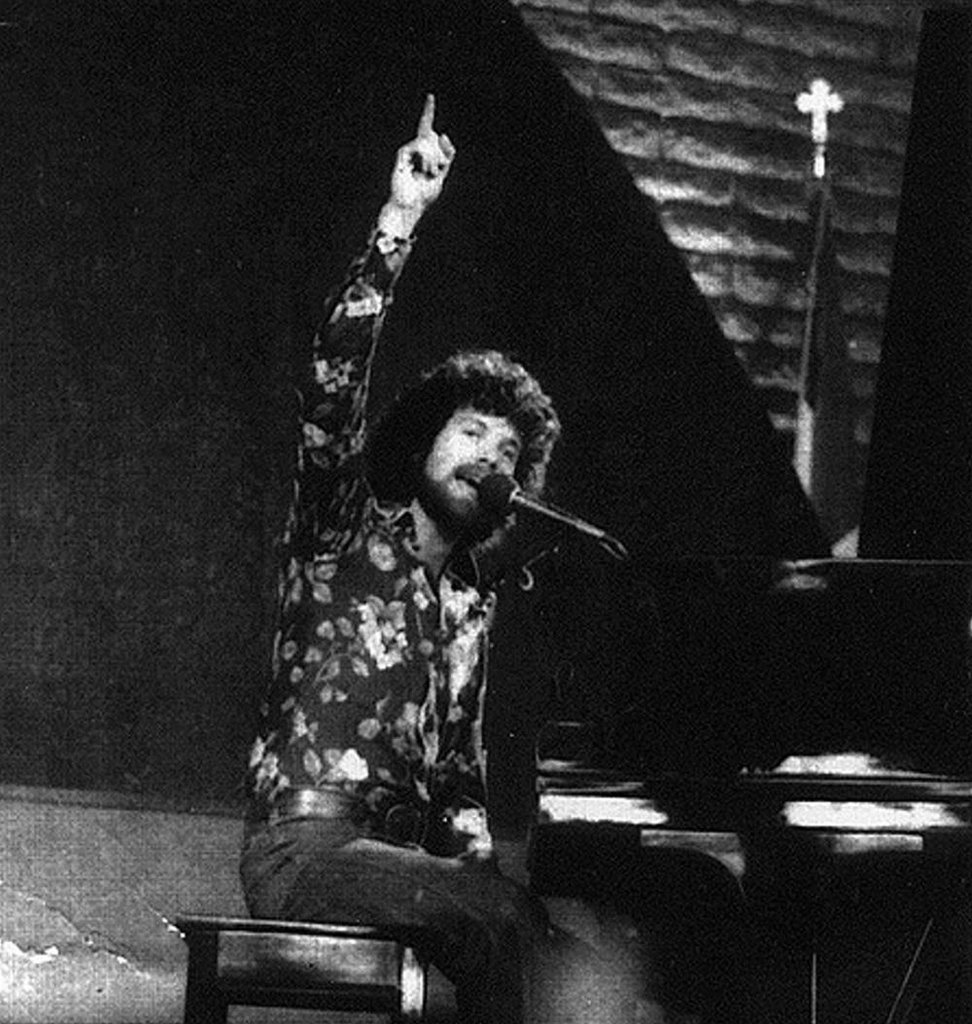
This Time Magazine cover story tells of the "Jesus Movement" in the late 1960s and early 70s, and the music of that generation.  It was a pivotal point in the history of church music, as an entire generation suddenly chose to use their own music and language to express their faith, salvation experiences, and worship. So real was this "revolution" that a concert and worship gathering in the Cotton Bowl in Texas, called "Explo '72", sponsored by Campus Crusade for Christ, drew some 80,000 young people (a crowd unheard of for that generation at a "religious" event).  The Jesus Movement gave birth to pioneer artists in Christian music, such as Love Song, Keith Green, 2nd Chapter of Acts, Barry McGuire, Phil Keaggy, Larry Norman, Randy Stonehill, Honeytree, and others.

Among the most notable artists of that "Jesus Movement" was singer/songwriter Keith Green.  His music is still sung by the church today, and is featured in current hymnals.  His music bridged generations and reflected the "One Way" (to Jesus) uncompromising faith of his own generation.

Southern Gospel greats, "The Imperials" began bridging musical styles in the early 70s, taking their traditional harmonies into a more contemporary style, adding a full rhythm section--yes, including drums and electric guitars!--and reaching a whole new audience as their popularity soared into the 1980s.  Dynamic vocalist Russ Taff was a product of this group.  Taff himself would go on to inspire an entirely new generation of young Christian singers.

Bill and Gloria Gaither.  Not much else need be said.  Their contribution to Christian music is almost immeasurable.  The catalog of music they have created crosses genres, generations, and people groups worldwide.  Their roots in traditional Southern Gospel would not keep them boxed into just one style.  Bill Gaither is currently considered to be the most successful "entertainer" in the history of Christian music. 

Fresh-faced Amy Grant began her career in Christian music as a 16-year old girl with a guitar in 1977.  She has motivated and inspired countless other young girls in her three decades as an artist, and her own music now fills churches everywhere.  She has written or co-written such current standards as "Thy Word Is a Lamp Unto My Feet",  "Tennessee Christmas", "Breath of Heaven (Mary's Song)", and more.

Pianist for Amy Grant and co-writer of many of her songs, Michael W. Smith came into his own as a solo artist in 1983.  Some of his songs include "How Majestic Is Your Name", "Great Is the Lord",  "Friends", "Place In This World", "Angus Dei", and "This Is Our Time".  His keyboard skills and  talent as a songwriter have earned him numerous awards throughout his career, and has even ventured into acting!  His latest role onscreen can be seen in the new movie, "90 Minutes in Heaven", due for release this fall.

One of the most successful and influential singer/songwriters of the 20th and 21st centuries--so far--is Steven Curtis Chapman.  From his small-town beginnings in Paducah, Kentucky, he has become an international artist with more accolades and awards than any other living Christian artist.  Known for the devastating loss of his daughter in a tragic accident, he and his wife continue a ministry as adoption advocates called "ShowHope."  His songs include standards such as "His Strength Is Perfect", "For the Sake of the Call", "The Great Adventure," "More To This Life", "The Glorious Unfolding", "Speechless", "Dive", as well as the now-standard wedding anthem, "I Will Be Here".

Chris Tomlin is one of the premiere singer/songwriters of the "Worship Music" genre that has grown exponentially in the last decade--due in no small part to his music.  He has written or co-written such worship anthems as "How Great Is Our God", "Holy Is the Lord", "Jesus Messiah", "Amazing Grace (My Chains Are Gone"), "White Flag",  "Whom Shall I Fear", "I Will Rise", "At the Cross (Love Ran Red)",  "Glory In the Highest" and many, many more.

One of the voices of the latest generation of praise and worship music, Bart Millard and "MercyMe" bring a pop style to an ages-old message.  As uncompromising as the music of Keith Green from the Jesus Movement, and as fresh as the music of Michael W. Smith, MercyMe carries the torch to a new generation, passing it on to the next, with the exhortation to give God the glory and honor and praise he alone is due.  MercyMe crossed genres recently with their song that sparked imagination of what heaven might be like, "I Can Only Imagine".  Other songs by MercyMe include "Shake", "Greater Is He", "The Hurt and the Healer", "In the Blink of an Eye", and a song featured in our newest Baptist Hymnal, "Word of God Speak". 

SSBC Musicians & Guests Worship Feature
As a finale to Worship Arts Month, we featured a worship concert by the musicians of SSBC and some guests.  Enjoy the video!

SSBC Musicians & Guests are:
Doug Phillips, Piano, Keyboards, and Instrumental Director
Monique Keppler, Keyboards
Marilyn Edwards, Keyboards
Jarett Smiley, Drums
Adam Holler, Percussion
Howard Thomas, Trumpet and Audio
Bruce Davidson, Acoustic Guitar
Becka Crask, Vocals
Michelle Hartman, Vocals
Michele Wilson, Vocals
Keith Wilson, Vocals, Trumpet, Flugelhorn, Guitars, Ban-tar
Adam Sprouse, Bass and Vocals
Austin Sprouse, Lead Guitar and Vocals


Sunday, August 23, 2015

Worship Arts Month, Part IV: "The Sounds of the Church"


For this fourth Sunday of Worship Arts Month, we looked at some history of music in the church, going back to instruments and historic moments from the Old Testament through the 19th century.

Painting from Old Testament era of a harp
Old Testament-era pottery painting of a Psaltery

Replica of a harp such as David would have played in Old Testament era

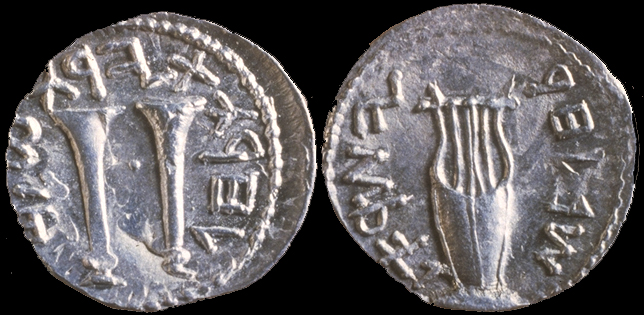
Coin from Old Testament time depicting horns on one side and a lyre on the other

Combination Lyre/Guitar from early 1800s

"Square piano" from the 1800s

Ira Sankey, called the "Father of Gospel Music"

Fanny J Crosby, lyricist and poet whose hymns are featured in thousands of hymnals still today


Here are some highlights of the history of "The Sounds of the Church"

A Bullet-Point History of Music in the Church

·       First mention of music in Bible…Jubal is said to be “father of all those who play the lyre and pipe” (Genesis 4:20-21)

·       Tabernacle worship is put into practice as vocal and instrumental praise is directed by David as the Ark of Covenant is delivered into the Tabernacle.  (1 Chronicles 16)

·       Psalms are all songs of praise and worship and confession.  It’s important to note that God found these songs important enough that they are included in the Bible.  David authored many of these Psalms, and was himself an accomplished musician.

·       In the 7th century, organs begin to be used in churches.

·       In the 11th century, the harp arrives in Europe, and the first German Christmas carol is written.

·       In 1640 the first major revised Psalm book was published in the colonies.

·       Johann Sebastian Bach, in 1725, had conflicts with the priesthood.  Nonetheless, he wrote many chorales for them during this time.

    Some interesting side-notes about Bach: 

Bach once said, ‘The aim and final end of all music should be none other than the glory of God and the refreshment of the soul.” 

As a church organist, Bach’s abilities were widely respected throughout all of Europe during his lifetime. When asked about his extraordinary organ skills he said, “There’s nothing remarkable about it. All one has to do is hit the right keys at the right time and the instrument plays itself.”

Whenever Bach was finished with a composition for the church, and was satisfied with it, he wrote the initials, “S.D.G.” at the bottom of the piece.  Soli Deo Gloria. “For the Glory of God Alone” He wanted to continuously remember that it wasn’t the accolades or praise or admiration that drove him to compose his masterpieces, but he did so for the honor and glory of God.

·       1750 - John and Charles Wesley, formed the first “invitation hymns”

·       1790 – The beginning of what is called “The 7 Great Awakenings.”  The 2nd Great Awakening, known for the Yale Revival, Camp Meetings, and the Red River Revival.

·       Baptists in New England began to merge folk melodies with classical hymns.  (What?? Pop music with hymn themes??? Baptists???)
     
·       During the 4th Great Awakening, Sunday School Revivals and the D.L. Moody and Ira Sankey campaigns.
  
·       1873 - This revival was headed up by the evangelist Dwight L. Moody and a musician named Ira D. Sankey. Moody's focus was to make services more interesting to draw people in, and he did this through Sankey. Sankey was considered the father of gospel music as he introduced many of the gospel hymns we know of today. This tag team traveled across America and spread the gospel like never before.


The feature of this Sunday was a "Hymn Sing,"  We sang a total of 28 favorite hymns today, each chosen by the church members themselves!  During a medley of 25 of those, we incorporated some stories of the hymn writers.  It was a special morning of worship and fellowship!

Highlights from the Hymn Sing:


Tuesday, August 18, 2015

Worship Arts Month, Part III

The third week of Worship Arts Month brought us another installment of "The Art of the Church," featuring 20th and 21st Century artists.  We saw artwork from African-American artist Thomas Blackshear, and from the "Painter of Light," Thomas Kinkade.

We concluded the three installments of "The Art of the Church" by watching a video of sand artist, Joe Castillo, and his creation titled "He Is Alive!"  That video can be viewed by following the link below.


We have also featured drama as one of the worship arts.  This past Sunday we focused on a dramatic skit titled, "Flunking Life", by Curt Cloninger, and featuring Adam Sprouse and Keith Wilson.


Next Sunday, August 23, we continue with Part IV of Worship Arts Month.  That will be a special Sunday, featuring "Hymns of the Faith," a service of your favorite hymns, as chosen by the church, to honor "The Sounds of the Church" and the history of music in Christianity.

We'll also be taking a look at that history, from the Old Testament through the 19th century.  I hope you will join us as we continue to celebrate Worship Arts Month!